On Jesuit scholarship, intercultural encounter, and the call to global understanding.
Amir Hussain, professor of theological studies
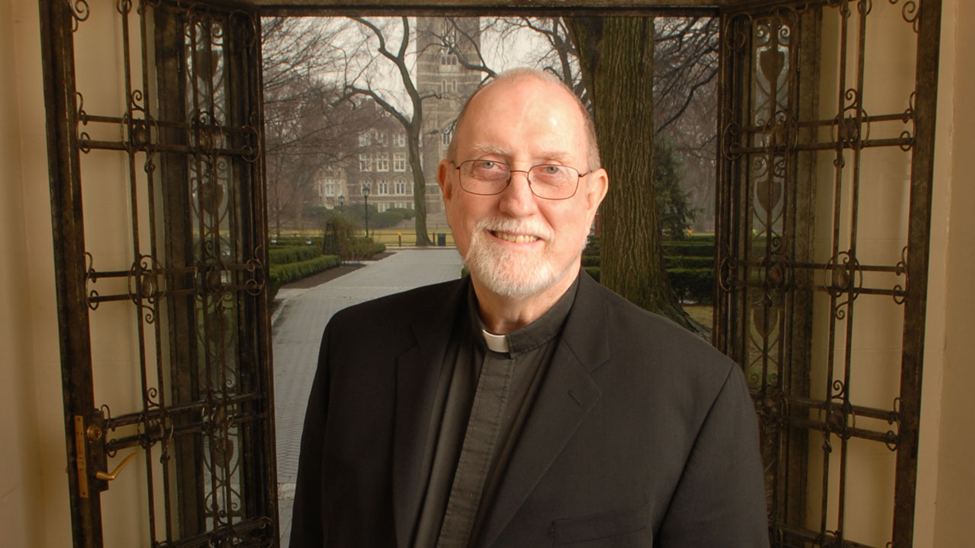
In teaching at LMU for over 20 years, I have been blessed to know a great many Jesuits, both at LMU and around the world. I write this reflection in memory of one of them, Fr. Patrick Joseph Ryan, who passed away on August 9. Pat was a Jesuit priest who spent almost half of his adult life working with Muslims in West Africa.
I first got to know Pat in 2008, just a few years after I started at LMU, at a conference at Georgetown University organized around the Common Word document that had been sent by Muslims to Christians inviting them to dialogue. Pat perked up at me mentioning my teacher, Wilfred Cantwell Smith, and he mentioned his teacher, Annemarie Schimmel, who both taught him at Harvard when he was a PhD student there. Wilfred was an extraordinary scholar of Islam, and Annemarie was really the key scholar on Sufism (Islamic mysticism) in the 20th century. That was part of the Jesuit mystique for me, that when Pat wanted to learn about Islam and Muslims, the Jesuits sent him to Harvard to do his PhD. However, it wasn’t just academic knowledge that Pat had. With the Jesuit emphasis on the education of the whole person, Pat put his book learning to practical experience, living with Muslims in Ghana and Nigeria for over a quarter of a century.
A life-long New Yorker (Pat was born in Queens and died in the Bronx), he became the McGinley Chair in Religion and Society at Fordham University in 2009. It was a singular honor for Pat, since the chair was created to bring Cardinal Avery Dulles (also a Jesuit and one of the greatest American Catholic thinkers of the 20th century) back to Fordham from the Catholic University of America. A note to students: when you replace a cardinal in an endowed chair that was created for him, you have some mad skills (as I think the young people are still wont to say).
As the McGinley chair, he invited me to give several of the responses to his talks, so there were times where I saw him twice a year at Fordham, both at Rose Hill and Lincoln Centre. Pat was an Irish priest, straight out of central casting, with the Irish lilt and red hair. I asked him years after we met about his accent, since he was born in Queens, and not in Ireland. He said that he was a product of Irish Catholic education, taught by nuns who were from Ireland, and that his early world was a two block Irish ghetto, which is where he picked up the Irish accent. Nevertheless, he was fluent in several African languages, and when we would travel together in New York City, he’d see the taxi driver’s name on his license, be able to tell from the name where in West Africa the driver was from, and start speaking to him in his native language. Startled, the taxi driver would look back at me, and then realize that it wasn’t the Pakistani Muslim that was speaking to him in fluent Wolof, but the Irish Catholic priest. Fr. Joseph McShane SJ, the legendary president of Fordham when Pat was the McGinley chair, was quoted in Pat’s obituary as saying that “Perhaps the best way of describing him would be to say that he was a man after the hearts of Saint Ignatius Loyola and Saint Francis Xavier and was therefore a citizen of the world, Jesuit style”.
Pat was a one. I knew him for 15 years or so, and I miss him, and his voice (with that Irish lit), and his marvelous sense of humor. He was one of the key Jesuit scholars doing comparative work on Islam, so his death is a loss to all of us who work in comparative theology. Sadly, there are too many places across the USA that claim that there is no time for comparative work when one must focus on Christology, and historical theology, and moral theology, and systematics. By contrast, Jesuit institutions in Africa or Asia do not have the luxury to share this, er, American exceptionalism. With the exception of the Philippines, they have to work in a world where the day-to-day lived reality is more likely to be with Muslims, Hindus, Buddhists, or practitioners of traditional religions than with fellow Christians (let alone other Catholics). Perhaps we in America might one day be able to learn this truth that Pat often taught us, that there is more to theological vision than is contained in any one religious tradition. Or that the goal of interfaith dialogue is not that we seek to convert each other, but that we help each other to find what is meaningful in our own religious traditions.